
|
Click to set custom HTML
|
Quarry Bank Mill - facts and fiction by G.J. Griffiths, Volunteer at Quarry Bank Mill November 2024 Left: Ardwick Hall before it was demolished in the 1970s Right: Quarry Bank House, Cheshire, in the autumn © National Trust Images / Annapurna Mellor Our volunteers have many stories to tell about life at the National Trust. This month G.J. Griffiths regales us with his tales - both factual and fictional - about Quarry Bank Mill in Cheshire . . . Now wash your hands! I first joined Quarry Bank Mill as a volunteer ranger having always been interested in wildlife and the natural environment. My tasks included helping to repair paths with muddy pot holes, clipping hedges and mowing grass verges. One day I was taking a group of about 20 children with their parents around the old mill pond. All the kids had turned up wearing their wellies and my main task was to encourage them about the awe and wonder of nature. On their way round, the children delighted in spotting birds, plants, slugs, snails, woodlice and beetles. Many of them rushed to inform me when they did. I was busy helping two little girls when I became aware of a lad of about nine or ten. He was after my attention, saying, "Sir! Sir!" I smiled and waited, and then he breathlessly said, "I’ve found a fossil! Look!" He was holding a small greyish-white object between his thumb and forefinger. Peering briefly at it I replied, "Now go back your parents and tell them you must wash your hands, before you eat your sandwiches. Now, tell them now!” Looking quite surprised and frowning slightly he said, “But what about my fossil?” I tutted, regretfully, and said, “Throw it away. It’s not a fossil. It’s a bit of dried-up doggy poo!” Right: The mill pond on a frosty winter morning at Quarry Bank Mill, Cheshire © National Trust Images / Derek Hatton Conducting school tours soon became my new role. It was easier on my aching back than helping to attend to the many grass verges and hedges around Styal village and the estate grounds. Plus working with the school children now included pond-dipping, which was something I had done many times with Year Seven. As a retired secondary teacher, leading the younger kids from primary schools on a tour had an extra appeal. There was no objection at all from the Quarry Bank staff when I asked to change duties. In fact, that is one of the things that make volunteering there so good - the pleasant and helpful people you get to know and work with. Ho! Ho! Ho! There was an occasion when the usual volunteer who played Father Christmas at Quarry Bank was unable to attend. I felt quite honoured to be asked to stand in for him and provide the appropriate joviality when entering the Styal Primary School Christmas party. “I’ve parked my sleigh somewhere in Chapel Woods. Ho! Ho! Ho!” I merrily told them. “Where?” piped up a little girl with tinsel in her hair. “Oh, I think it’s somewhere . . . erm, behind Norcliffe Chapel!” I replied. Right: G.J. Griffiths dressed as Father Christmas at Quarry Bank Mill, c2016 (Image: G.J. Griffiths) On another occasion when I was standing in, I was provided with a quite amusing, if startling story to relate to my family later. A young mum and dad entered Santa’s grotto with their babe in arms. The child looked at me and her lower lip quivered. It was obvious she was about to weep buckets of tears. I suggested the little one sat on my knee; many of the very small children had previously been quickly distracted by the glittery wrapped gift from my sack. Her mum immediately said, “OK,” and advanced towards me. Then, she promptly sat on my lap, holding the child. Dad was smiling behind his camera saying, “That’s great! Come on, Susy, give Daddy a big smile now! You too, Emma . . . Lovely! Hold it!” I don’t suppose Daddy had quite captured my shocked look, blinking rapidly under my raised eyebrows and behind the enormous white beard. I was thinking of course: Oops! I don’t think this is part of my brief. Volunteer Tour Guide When I had changed to acting as a tour guide, for school children as well as for adults, some ideas were forming in my head about writing a story. It would be about the 200-mile journey taken, on foot, by boy apprentices Thomas Priestley and Joseph Sefton from Styal in Cheshire to London. Little was known about the journey itself and I asked for permission from the General Manager, Eleanor Underhill at that time, to commence writing my first historical novel - The Quarry Bank Runaways. She had no objections provided that any information in it referring directly to Quarry Bank Mill was accurate historically. This was particularly important since a recent film called The Mill, filmed on the site and shown later on Channel 4, had some scenes that could not have factually occurred during the timeline of the film. Quarry Bank Tales series of 5 books: The Quarry Bank Runaways, Mules; Masters & Mud, The Mule Spinners' Daughters, Seeking Angels and Seeking Truth at Quarry Bank House During the research for each book, I came across various pieces of information linked to Quarry Bank. After The Runaways, I was inspired by the events that took place during the Peterloo Massacre, when many qualified spinners wanted to join unions, to write Mules; Masters & Mud. Samuel Greg and his son, Robert, later appeared in court as witnesses to the protest demonstrations in St. Peter’s Field. When I learned about a robbery in 1841 from the Quarry Bank Mill manager’s office, I was curious to know how this robbery might affect Thomas and Joseph. After all, by then I had given them both families of their own. The Mule Spinners’ Daughters was an opportunity to explore this. The fourth book, Seeking Angels, was inspired by the poverty and serious crime in Angel Meadow, Manchester, and it meant I could bring back Inspector Button from the third book. Seeking Angels and Seeking Truth at Ardwick House Research had told me more about the growth of the railways and a large local ironworks foundry in nearby Ogden Street, Ardwick. My idea was to create a wealthy owner from Scotland who was now living in a mansion, once owned by Samuel’s uncle, Nathaniel Hyde, in Ardwick Green. Seeking Truth at Ardwick House is about a violent robbery there, requiring Inspector Button’s investigating skills once again. The things they say! Conducting school children around the cotton mill, with its many machines: looms, spinning mules, the mill waterwheel and so on can be very exciting as well as educational for them. As a retired teacher one would think it not likely that I would hear any of them say something surprising to me. But not at all. More than once after taking them through the weaving room and explaining how the loud noise of the looms can cause workers to lose their hearing, an observant pupil has spotted my hearing aids and asked me, “Did you used to work here, Sir?” Right: Detail of machines threaded with cotton at the newly restored mill at Quarry Bank Mill, Cheshire © National Trust Images / Paul Harris Having told the children about the various stone quarries on the estate, the River Bollin and the damp atmosphere in the valley helping cotton fibres to bind into a yarn, I would follow it up later with the question: “Why did Samuel Greg choose this site for his mill?” One day a bright lad put up his hand and seriously answered with, “It’s very near the airport.” I often tell them about Hannah Greg’s dowry of £10,000 to Samuel when they were wed. Once I’ve explained what that means, a pupil will ask, “What’s a dowry?” So, it means I need to explain that the father of the bride usually gives the dowry to her husband. A boy always exclaims, “Wow! Do they still do it?” My current role is as an engagement volunteer in Quarry Bank House, the family home of Samuel and Hannah Greg. I have learned so much about the Industrial Revolution and the social history of the various levels of British society that I enjoy expounding to visitors every time I am there. However, I was surprised when one day a visitor called Hilldrup told me that he was born in Quarry Bank House. But according to archives, his family had indeed rented the house in the 1950s. The Peterloo Massacre commemorations 2019 The commemorations of the Peterloo Massacre that took place in Manchester in the summer of 2019 also became significant for some of the personnel from Quarry Bank Mill. Many staff and volunteers from Quarry Bank were also among the audience in Manchester Central Library. They had come to view Trebuchet, a folk band who sang a number of typical songs about those turbulent times. The lead singer was Keith Carter Harris, a Quarry Bank storyteller. I was there to read out passages from Mules; Masters & Mud, between the songs. John-Paul Hurley, Ian Mercer, Rory Kinnear and Neil Bell in Mike Leigh's historical drama - Peterloo © Simon Mein / Amazon Studios Earlier in 2019, I was fortunate to receive an invitation to view a screening of director Mike Leigh’s film Peterloo at Salford University. I went along with a group of others from Quarry Bank including Keith Carter Harris. The film was followed up with a Q&A session with Mike Leigh and Maxine Peake. Apparently the two had roots in the Salford area; Mike Leigh had attended Salford Grammar. Maxine Peake was in the film as Nellie, the mother of a returning infantry man. Curious about that family, I asked about their validity and origins. “There aren’t any,” replied Mike, grinning. “We made them up!” “Oh!” was all I had to say, sighing with relief and thinking: it’s probably OK then to write what I had invented about the families of Joseph Sefton and Thomas Priestley, my two runaway characters from the Quarry Bank cotton mill. |
ABOUT G J Griffiths: A writer of wrongs (WoW)
G J Griffiths is a retired science teacher with some early working experience of the photographic industry. Born in the UK he enjoys reading most genres of fiction such as sci-fi, crime/detective thrillers, historical and wildlife stories. Non-fiction reading mainly includes scientific or historical books. Walking in the English, Scottish or Welsh countryside with binoculars ready for bird-watching or other wildlife is a particular pleasure. Seeing badgers and otters in the wild recently was an exciting first.
His first novel was Fallen Hero and the So What! series of three books followed and which are all focussed around the fictitious Birch Green High School. More recent works include poetry: Dizzyrambic Imaginings, two illustrated children’s sci-fi stories about ant-size aliens and historical novels based upon real characters from the Industrial Revolution period: The Quarry Bank Tales. G J is now a tour volunteer at Quarry Bank Mill Museum, from where he researched much of the intriguing details about some of the characters to be found in The Quarry Bank Tales.
If you enjoy reading any of G J Griffiths’ books please share your enjoyment with other readers and post a review. This is very helpful for new writers. G.J. would be pleased to hear from you on a Comments page at his website: http://www.gjgriffithswriter.com
or on GOODREADS:
https://www.goodreads.com/author/show/6491167.G_J_Griffiths
Here is the link to my interview with Awesomegang
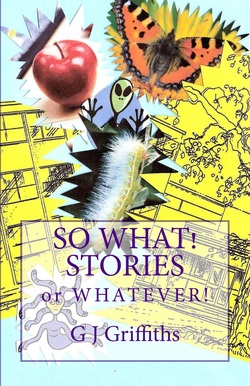
<Click on this book cover for a link to Amazon UK.